.svg)

How long can you really trust your sensor to sip energy from its batteries? Properly selecting the right sample interval must strike a balance between a high-resolution dataset and a complete time-series. After some quick calculations, we’ve found the optimal sample intervals to achieve anywhere from 60,000 – 1,100,000 pH samples into a high-resolution, year-long pH dataset.
Battery endurance for our line of ISFET pH sensors varies with the sampling regime: are you transmitting data in real-time? Do you have a CTD? Are you powering that CTD from its own batteries, or from the SeaFET? We stepped through some power estimations for create the table below, assuming a sensor with brand-new batteries is deployed in 17 °C water.
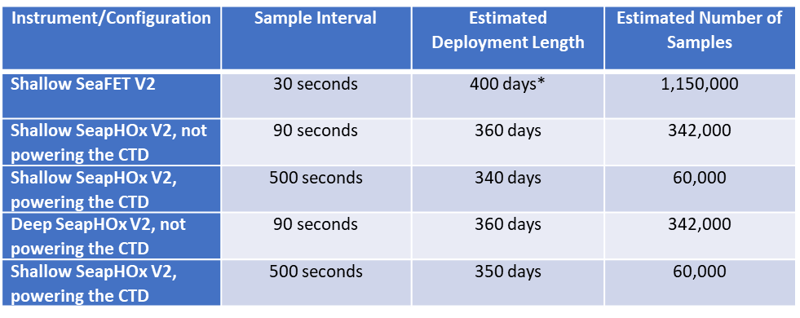 * Note: The DuraFET is rated for 1-year of accuracy
If there’s any takeaway here, it’s that the SeaFET V2, SeapHOx V2, and Deep SeapHOx V2 can be configured to provide a data-dense long-term time series, previously unachievable with other pH-sensing technology. Also, it certainly helps to deploy a SeapHOx V2 or Deep SeapHOx V2 with batteries in the CTD—if necessary, you can always configure a drop-in replacement to extend the CTD’s deployment endurance.