.svg)

Glider Payload CTD (GPCTD)
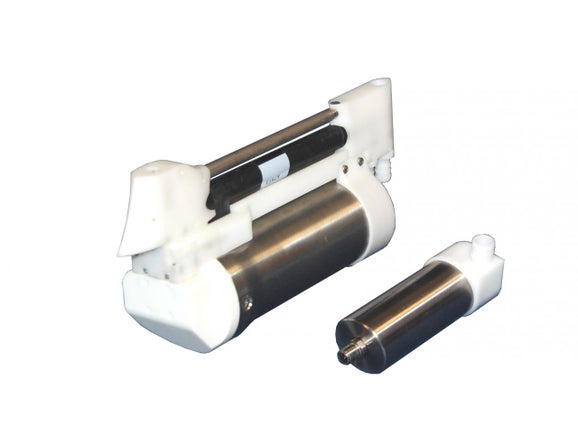
The GPCTD is a modular, low-power profiling instrument for autonomous gliders with the high accuracy necessary for research, inter-comparison with moored observatory sensors, updating circulation models, and leveraging data collection opportunities from operational vehicle missions. The externally powered, continuously pumped CTD consumes only 175 mW recording at 1 Hz (190 mW for real-time data). One Alkaline D cell could operate the CTD continuously for 114 hours (9.5 days at 50% duty cycle, profiling continuously at 1 Hz on every glider upcast); one Lithium DD cell could provide 48 days continuous profiling on every upcast. Data are output in engineering units. The GPCTD can optionally be equipped with an SBE 43F Dissolved Oxygen sensor.
Added to quote
Key Features
- Conductivity, Temperature, Pressure, and (optional) Dissolved Oxygen (modular SBE 43F DO sensor).
- Pressure-proof module allows for exchange of CTD (and DO sensor) without opening glider pressure hull. – Assembly visible on glider exterior consists of intake sail (with integral T-C duct and anti-foulant device), internal field conductivity cell, and exhaust sail with pump connections. Intake sail allows measurements to be made outside vehicle’s boundary flow (where old water is thermally contaminated by vehicle). Pump pulls water into intake sail, past temperature sensor, through anti-foulant device and conductivity cell, and out exhaust sail (preventing exhaust re-circulation and Bernoulli pressure differences from changing flow rate). Outside of conductivity cell is freeflushed. minimizing salinity errors. Connecting neck, electronics, pump, and DO sensor are in a flooded space inside hull, placed so that tubing lengths are minimized (between conductivity cell and pump intake, and from pump outlet to sail exhaust fitting), sharp bends are avoided, and pump and tubing are oriented to avoid trapping air that will interfere with pump priming.
- RS-232 interface, memory, real-time output, no batteries (for use on vehicles that can supply power).
- Four sampling modes: Continuous (1 Hz), Fast Interval (5-14 sec intervals), Slow Interval (15-3600 sec intervals; CTD only), and Polled. – Continuous sampling time series suitable for corrections (e.g. response filtering, alignment, thermal mass correction) for dynamic errors in data. – File headers (maximum 1000) contain beginning and ending sample numbers, sampling mode and interval, and starting date/time.
- Unique flow path, pumping regimen, and expendable anti-foulant device, for maximum bio-fouling protection.
- Pump-controlled, T-C ducted flow to minimize salinity spiking.
- Depths to 350 or 1500 m.
- Field-proven design based on Argo float CTD, with more than 15,000 Argo float CTDs deployed.
- Seasoft© V2 Windows software package (setup, data upload, data processing).
- Five-year limited warranty.
Parameters Measured
Specifications
| Specification | Value |
|---|---|
| Communication Options | RS-232 |
| Depth Rating (Meters) | 350m, 1500m |
| Power Source | External |
| Housing Material Options | Titanium, Plastic |
| Connector | MCBH |
| Sampling Rate | 1 Hz (1 sample/sec) maximum |
| Memory Capacity (Samples) | 8 Mbytes; 699,000 samples CTD (194 hours at 1 Hz) or 559,000 samples of CTD & DO (155 hours at 1 Hz) |
| Power Consumption | 8 to 20 VDC nominal. CTD only: 175 mW recording at 1 Hz; 190 mW transmitting real-time data. CTD & DO: 265 mW recording at 1 Hz; 280 mW transmitting real-time data. |
| Accuracy | Conductivity In calibration range: ±0.0003 S/m; Outside calibration range: ±0.0010 S/m 1 Temperature 0 - 5 VDC (SBE 43), frequency (SBE 43F) Pressure In calibration range: ±0.1% of full scale range |
| Software | Seasoft© V2 |
| Resolution | Conductivity 0.00001 S/m Temperature 0.001 °C Pressure 0.002% of full scale range |
| Biofouling Protection | Yes |
Content
See how our experts at Sea-Bird Scientific execute field procedures and deploy our products.
Accessories
Curious what accessories and spares you can purchase for the Glider Payload CTD (GPCTD)? Get in touch with our experts for more information.
Contact us