.svg)

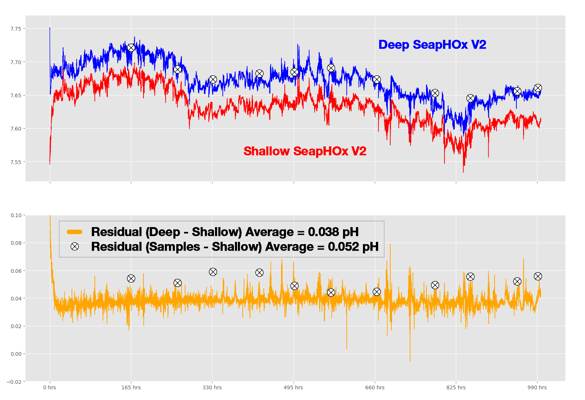
The data shown above come from a SeapHOx V2 (red) and Deep SeapHOx V2 (blue) deployed next to one another in a dynamic estuarine environment. Regular pH validation samples were collected throughout the time-series. According to the 0.05 pH accuracy spec of each sensor, there really isn’t much to be concerned about: both sensors agree with one another within spec (sensor residual average = 0.038 pH) and the overall gap between each sensor’s data is miniscule compared to standard glass electrodes. Furthermore, the difference between validation samples and the Shallow SeapHOx V2 is within spec when considering the accuracy of the samples themselves. That being said, ISFET pH sensors can and should do better, and recent optimizations in Sea-Bird Scientific’s calibration process show that this is true.
Recalibrating the Shallow SeapHOx data with a new method yielded significant gains in accuracy throughout the entire 1000 hour time-series. The new pH calibration method takes inspiration from Sea-Bird Scientific’s established history of calibrating CTDs, sweeping pH sensors across a wide range of temperatures for a more refined calibration in a highly stable calibration bath. After reprocessing the data with the improved coefficients, the sensor’s output outperformed its expected accuracy specification by a sizeable margin.
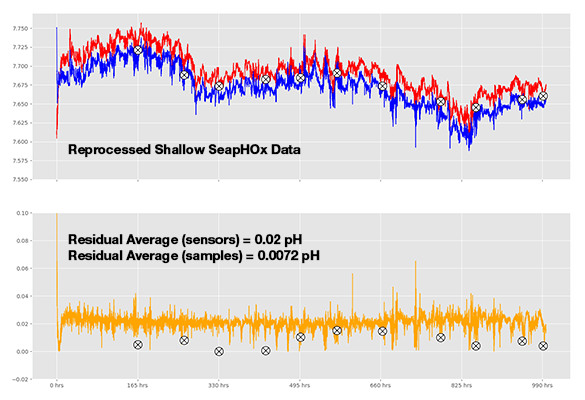
All ISFET pH sensors leaving Sea-Bird Scientific’s facility now benefit from the new calibration method. This includes the SeaFET V2, SeapHOx V2, Deep SeapHOx V2, and Float pH.