Tech Tips

Q&A: Moored Data Excursions

Posted on 02.01.2020

Temperature and salinity charts

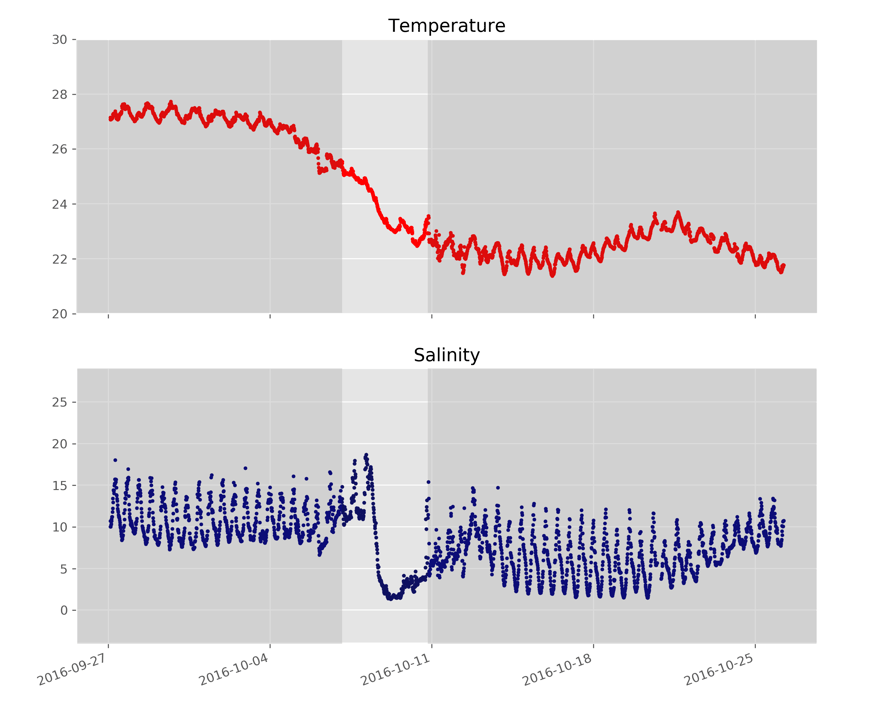
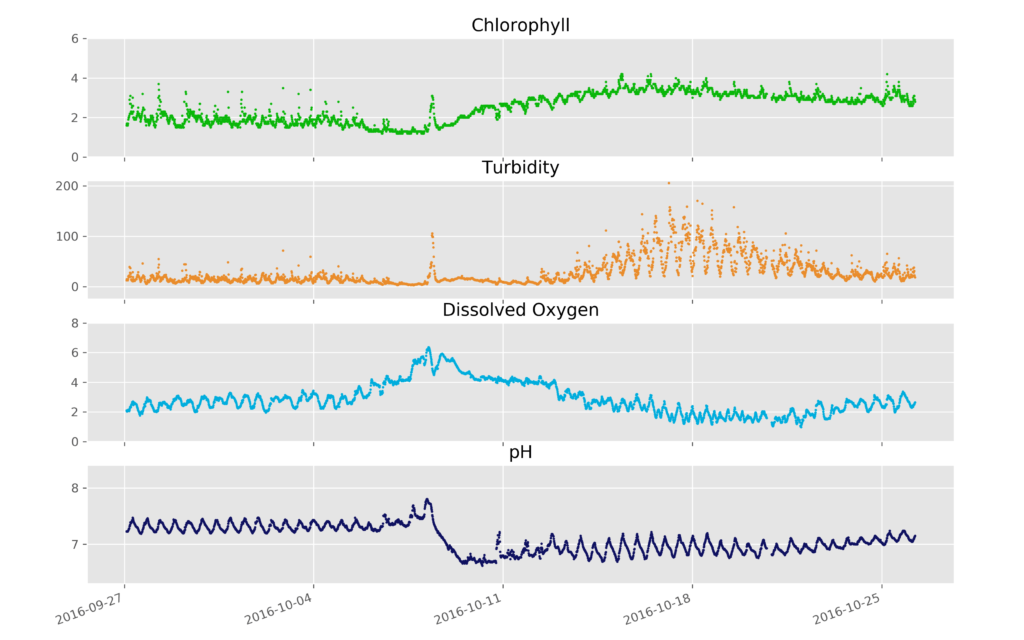
The data above came from a HydroCAT-EP multiparameter probe moored in an estuary near Savannah, Georgia. The highlighted section shows a sudden change in the temperature and salinity data that lasted for approximately 4 days, and continued with smaller effects for days after. What could have caused this turn, and what do you think happened to the other parameters measured by the instrument?
Chlorophyll, Turbidity, Dissolved Oxygen and pH Charts

These data were collected in 2016 as Hurricane Matthew swept across Georgia’s coast. On March 7, 2016, heavy weather struck the monitoring site where a HydroCAT-EP was installed. Because this sensor simultaneously measures several parameters (temperature, conductivity, pressure, dissolved oxygen, pH, chlorophyll fluorescence, and turbidity), the instrument captured the unique signals of the hurricane. The most notable features include a sudden drop in salinity that barely rose with tidal inflow, and increased turbidity for several days after the hurricane.

5 Inductive Modem Configurations
Tech Tips
06.16.21
5 Inductive Modem Configurations
IM systems eliminate the need for connectors entirely, transforming a mooring's tether into a medium for real-time data transmission.
Learn More
RS-232 Sensor Integration Guide
Tech Tips
02.23.21
RS-232 Sensor Integration Guide
%%excerpt%%
Learn More
Q&A: Temperature Mismatch
Tech Tips
01.26.21
Q&A: Temperature Mismatch
Although they should match perfectly, the two sensors rarely reported the same temperature value throughout their deployment. Can you identify the problem? Hint: this problem is a prime example of the benefits of data visualization for troubleshooting.
Learn More
Get in touch

Contact our team

Ready to take the next step? Connect with Sea-Bird Scientific’s team for personalized guidance, support, or to request a quote for our solutions.