.svg)

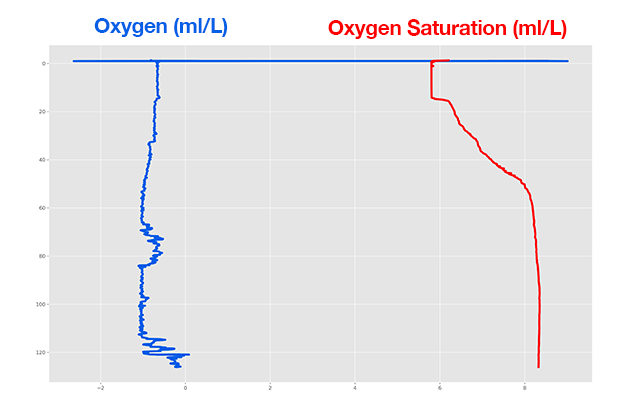
Oxygen at this location is historically around 90% saturation at the surface. However, after uploading data from this CTD, the data from the SBE 43 oxygen sensor appeared to be averaging around -1 mL/L - obviously incorrect. After running through common SBE 43 troubleshooting tests, this sensor and cable appeared to be working properly. Can you determine the error that created the unusual oxygen profile above?
Answer: Incorrect Configuration File
The hardware used in this cast was working as expected – this problem was software-related. The .xmlcon configuration file was not arranged properly, resulting in dissolved oxygen data being processed as turbidity data (and vice versa) in post-processing . The error and necessary correction are shown below:
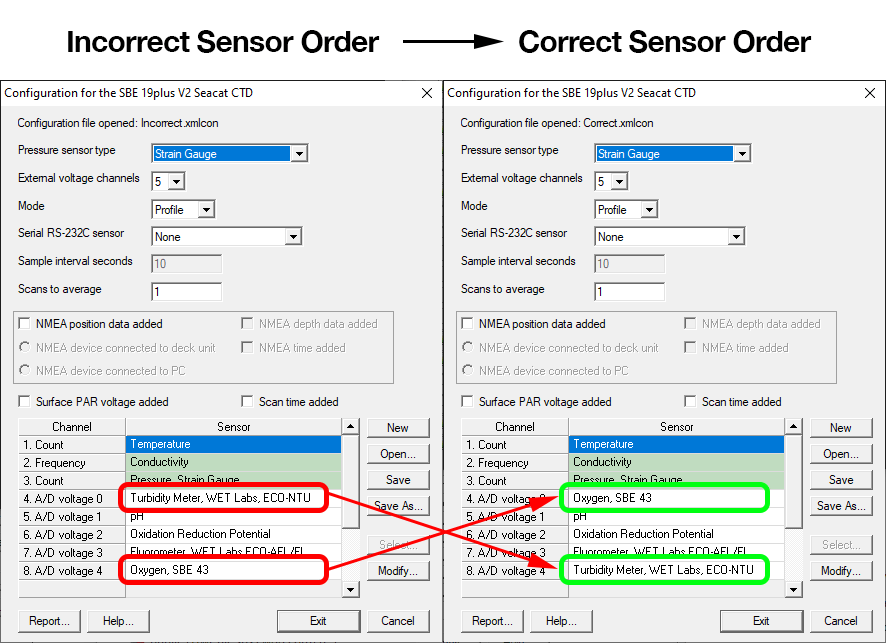
In the original configuration file, the order of sensors was incorrect - the position of the dissolved oxygen sensor was switched with the position of the turbidity sensor. This was incongruent with the order that sensors were physically connected to the CTD’s auxiliary sensor channels, where the SBE 43 dissolved oxygen sensor was physically connected to the CTD’s auxiliary channel 0 and the ECO-NTU turbidity sensor was physically connected to the CTD’s voltage channel 4. When the user loaded the incorrect .xmlcon file into SBE Data Processing, the software interpreted the analog output from the turbidity sensor as data from an oxygen sensor, resulting in the unusual oxygen profile shown above. Correcting the .xmlcon file and reprocessing data fixed the error.
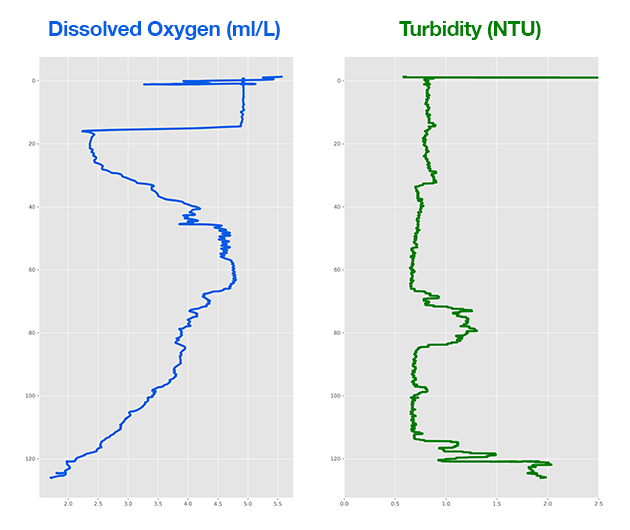
Analog-output sensors like the SBE 43 and ECO-NTU can be easily integrated with many Sea-Bird Scientific CTDs, adding a vast array of parameters and customization options. But beware – changing the physical sensor array necessitates changes to the .xmlcon configuration file. Failure to do so will cause the software to misinterpret the data. Read our analog sensor integration guide to learn more.