.svg)

January 2019 Newsletter
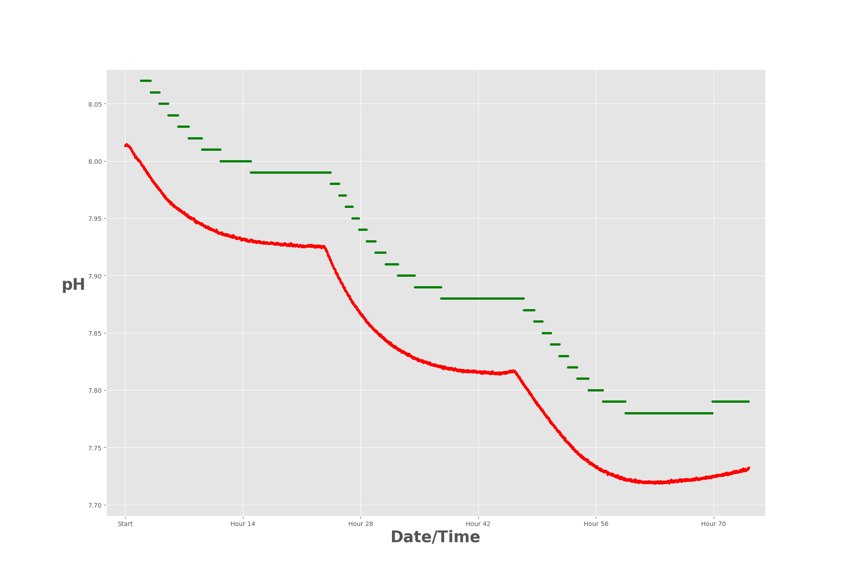
The data shown above originate from two different pH sensors deployed in the same well-mixed test bath. Both sensors were cleaned, tested, and calibrated before deployment, and were given 24 hours to equilibrate before recording data. So why does each sensor appear to be offset from the other, and why does the sensor shown in green appear to have gaps in data?
Answer: these data came from two different types of pH sensors – a SeapHOx V2 with an ISFET pH sensor (red) and the HC-pH glass electrode pH sensor installed on a HydroCAT-EP (green). The four black bars in the figure above mark validation samples from a spectrophotometer, with error bars denoting the ±0.01 pH accuracy of that method.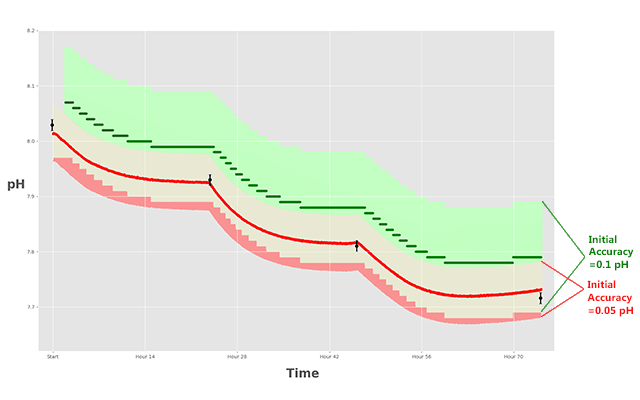 These results highlight two noteworthy differences between each sensor technology:
- Initial Accuracy: the SeapHOx V2 has an initial accuracy of ±0.05 pH or better, while most glass electrode pH sensors (the HydroCAT-EP included) have an initial accuracy of ±0.1 pH. The figure above demonstrates each sensor’s accuracy with the shaded area around each line (light green = HC-pH accuracy, light red = SeapHOx V2 accuracy, yellow= overlap). Based on the validation samples, both pH sensors were reporting data within their accuracy specifications, but the SeapHOx V2 was clearly more accurate from start to finish.
- Sampling resolution: the “stepwise” changes in the HC-pH data are the result of lower resolution. The sensor is unable to resolve changes lower than 0.01 pH, so small changes in pH aren’t recorded until a large enough change can be detected. The SeapHOx V2 is able to resolve small changes of up to 0.004 pH, resulting in smooth lines as pH drops.