.svg)

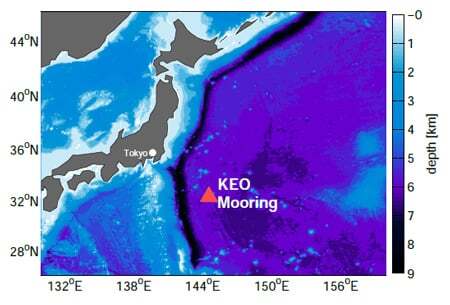
An ocean mooring can help with more than publishing research papers. When sensors can talk to the buoy controller, and the buoy controller can call home, real-time moorings can provide useful data for short-term regional storm forecasting. Such was the case with Pacific Marine Environmental Lab’s (PMEL) Kuroshio Extension Observatory (KEO) Mooring when Typhoon Choi-Wan passed by.
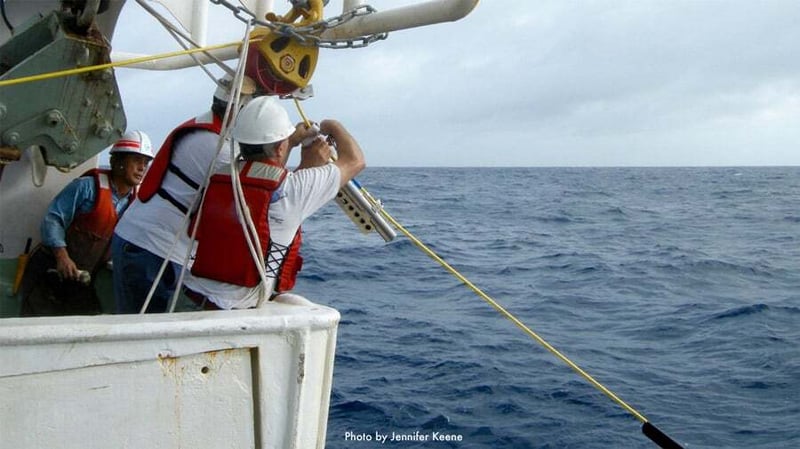
Operated by NOAA’s Pacific Marine Environmental Laboratory (PMEL), the Kuroshio Extension Observatory (KEO) mooring is one of several Ocean Climate Stations collecting crucial oceanographic data in the open ocean. At its heart is the Sea-Bird Scientific Inductive Modem telemetry system, relaying real-time data from a dense array of sensors, including the SBE 37-IM moored CTD and SBE 39-IM temperature sensor. Along with subsurface CTDs, the mooring is equipped with a collection of current meters integrated with the Sea-Bird UIMM or SBE 44, and surface sensors logging environmental conditions. All data are transmitted back to land in real-time.
Real-time moorings like KEO provide vital data for ongoing research, adding data to long-term meteorological and climate models and providing insight into complex oceanographic processes. Of course, real-time data also provides an instant set of eyes for short-term forecasting in a harsh environment; during the hurricane season, storms regularly pass within 500 nautical miles of KEO.
The value of this data was immediately evident when Typhoon Choi-Wan raged 40 km from KEO as a Category 1 typhoon. Short of sending a research vessel into the eye of the storm, KEO represented the best opportunity to study the tropical cyclone’s effect on the open ocean and utilize real-time data for regional forecasting. And once the storm cleared, KEO had provided ample data for physical oceanographers to glean valuable insight into how the storm’s wake affected conditions below the surface.