.svg)

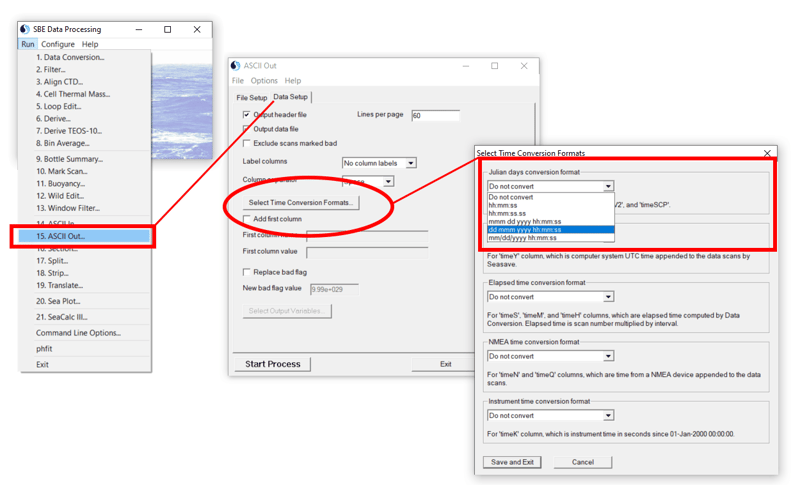 “Julian Days” is a numerical timestamp format, calculated by Sea-Bird Scientific CTDs as the number of the days since Jan 1 of that year (e.g., noon on Feb 3 = 34.5). While this format is useful, it is usually more convenient to display data in a visual format such as “2020-02-03 12:00:00". Learn how to convert Julian Days to standard formats using tools like SBEDataProcessing, Excel, and Matlab. Exporting “Time, Elapsed: Julian Days” from CTD data provides a count of days since Midnight on Jan 1 of that year, as referenced to the CTD’s timestamp. Some examples:
- Midnight on January 1st: timeJ = 1
- Midnight on January 2nd: timeJ = 2
- Midnight on February 1st: timeJ = 32
- Noon on February 1st: timeJ = 32.5
- Sea-Bird Data Processing: Use Time conversion in ASCII out
- In Excel: 1/1/2020+timeJ-1
- In matlab: datenum(2020, 1, 1)-1+timeJ
- In Python: d = datetime.date(dyear, 1, 1) + datetime.timedelta(yday - 1)
- In R: time1 <- ISOdatetime(year, 1, 1, 0, 0, 0, tz='UTC') + (jday - 1)*86400