.svg)

At Sea-Bird Scientific, our ultimate goal is to help scientists and researchers better understand our oceans so they can help policy makers make informed decisions about ocean conservation policy, ocean resource utilization, and more, through accurate and quality data.
Enabling the science that matters
The oceans are arguably our most critical resource, covering 70% of our planet and supplying us and billions of other organisms with food, shelter, and other resources. We take pride in our involvement in critical ocean research programs around the globe, through providing scientists with the instruments they need to acquire quality data. One of these important programs is the Argo Program.
What is the Argo Program?
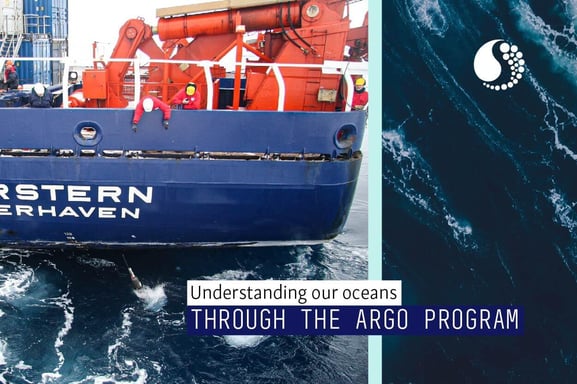
The Argo Program is an international ocean research program that aggregates data from autonomous floating robots that drift independently throughout the ocean and move up and down the water column at designated intervals to collect data. The robots are known as, "floats," and traverse the open sea for extended periods of time. As of August 3rd, 2021, there were over 3800 floats deployed and drifting around the globe.
"Data from Argo allows for unprecedented spatial coverage of the world’s oceans, with approximately one float per 3-degree box across the global ocean, where it is deeper than 2000 meters. " (Argo Program)
The below chart illustrates the sheer number of floats and their contributing country:
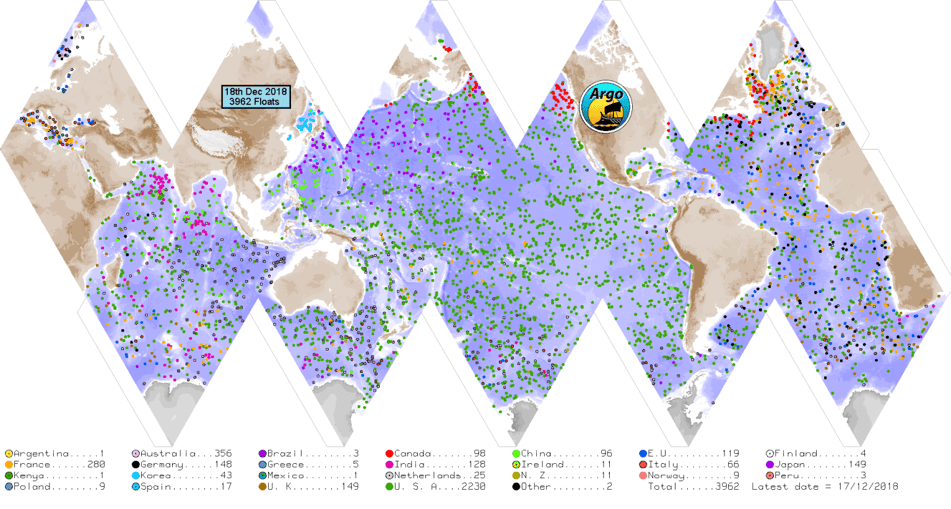
Photo courtesy of argo.ucsd.edu
Want to know more data surrounding the Argo Program? We've created an overview of the Argo Program in numbers here.
Curious about the history of the Argo CTD? We've created an overview here - starting with the creation of ALACE floats (Autonomous Lagrangian Circulation Explorer). View the full Argo Program story map here.

Photo courtesy of argo.ucsd.edu
Why is the Argo Program important during World Oceans Week?
The Argo Program provides a variety of measurements that can help inform scientists of how our oceans are changing. Sea-Bird Scientific is the provider for many of the sensors which are integrated on a large number of Argo floats, outfitting them with our immensely accurate instruments as they continue to traverse the globe, collecting an extensive amount of data.
"A key objective of Argo is to observe ocean signals related to climate change. This includes regional and global changes in ocean temperature and heat content, salinity and freshwater content, the steric height of the sea surface in relation to total sea level, and large-scale ocean circulation." (Argo Program)