Sea-Bird Scientific instruments spent nearly a decade lost at sea, yet still garnered reliable oceanographic data
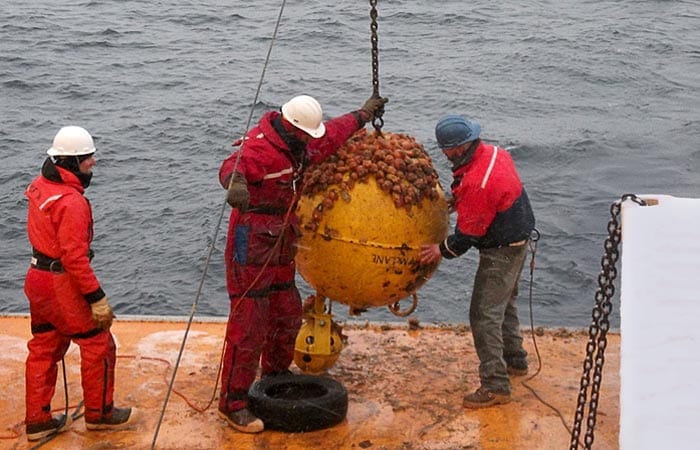
Oceanographers locate a buoy after being lost at sea for a decade. Photo: Courtesy of WHOI
The Mooring That Wouldn't Stay Lost
How do you study ocean currents and ecosystems in one of the world's harshest environments? You deploy world-class oceanographic instrumentation that can withstand freezing temperatures and pressure. In 2001, Scott Worrilow, who manages the Sub-Surface Mooring Operations Group at Woods Hole Oceanographic Institution (WHOI) along with a group that included WHOI engineer Jim Ryder, placed 6 deep-water moorings, strung with Sea-Bird Scientific instrumentation amongst others. On the mooring, was the tried and trusted SBE 37 MicroCAT along with a SBE 39plus Temperature Recorder, both flagship moored instruments from Sea-Bird Scientific for long-term monitoring in challenging environments.
The moorings were part of a long-term project to study the currents that flow south along the peninsula’s west coast and into Marguerite Bay, a nursery for the krill that feed Antarctic cod, penguins, leopard seals, and whales. The work was led by WHOI scientists Bob Beardsley, Breck Owens, and Richard Limeburner, together with MIT/WHOI Joint Program graduate students, including Carlos Moffat, who planned to use the data for his Ph.D. research. Placed across a deep channel, the instruments would collect data on how currents and ice moved around this part of Antarctica.
When the team returned in 2002, five moorings came up. The sixth did not respond to the acoustic signal to release its anchor. “It was a vital mooring, and it didn’t come back at all,” Beardsley said. “It was kind of a puzzle because the acoustic releases are extremely reliable.” Worrilow then tried to drag a thick wire along the seafloor to trip the stuck line, an approach that usually works. Instead, the drag line pulled the ship’s winch off its mount and sent it skidding across the deck. The attempt failed, the team called it quits, and the mooring was left behind.
Fast forward to April 2011, a decade later, Worrilow was checking his computer when he found an alert that a mooring had surfaced unexpectedly. He assumed it was part of a line of moorings placed the year before in the Northwest Atlantic, however, the signal actually came from a much older mooring: the lost mooring from 2001.
Almost a 10 years later, the lost mooring had surfaced on its own, with enough battery power to turn on its transmitter and broadcast its position. A ship working in the same region recovered it, and all of its instruments were still attached. They had recorded data for far longer than the one year originally planned. Juan Botella, a teacher who took part in a research cruise in the Southern Ocean, describes the recovery in a WHOI video.
The instruments attached to the mooring spent the better part of a decade in the cold, high-pressure, biologically active water of the Southern Ocean, with no maintenance and no chance of recovery.
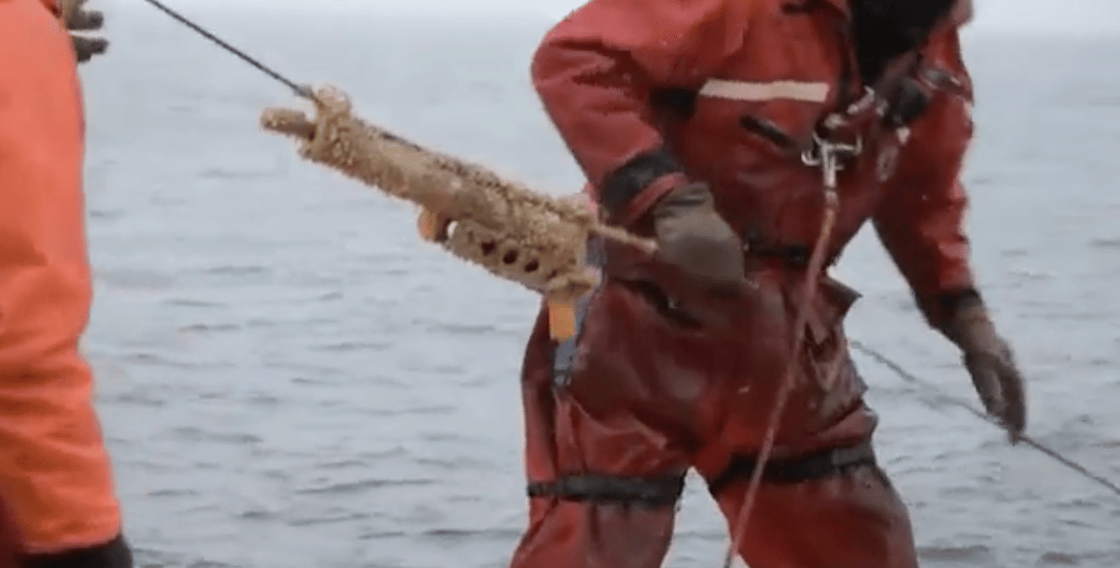
Video screenshot of the SBE 37 MicroCAT attached to the ghost mooring. Photo: Courtesy of WHOI Ghost Mooring Video
Reliable Instrumentation Delivers Defensible Data
Ocean observing depends on instruments that keep working where no one can reach them. A mooring can sit on the seafloor or in the water column for a year or more, exposed to pressure, cold, corrosion, and fouling. If an instrument fails, the loss goes beyond the hardware. It takes away the observations and the research built on them. The Antarctic moorings were meant to provide the first data on how currents and ice move around that part of the peninsula, and a graduate student was planning to use the data for his Ph.D. research.
Durability also protects the investment. A ship expedition to deploy and recover a mooring is costly and may happen only once. Instruments that survive the unexpected, such as a failed release or a recovery that is years late, give scientists a margin of safety that few other tools can offer.
Sea-Bird Scientific has spent decades earning the trust of the ocean science community, one deployment at a time. That trust is built on instruments that come back from the field and deliver. Researchers choose Sea-Bird Scientific because they cannot service an instrument once it is in the water, and because the data has to be right when it finally surfaces.
The ghost mooring is that legacy in action. A SBE 39plus Temperature Recorder and a SBE 37 MicroCAT CTD sat in the Southern Ocean for more than ten years, far beyond their planned deployment, and the data came home with them. Most lost moorings are never seen again. This one was, and the instruments attached to it had kept doing their job.
A long track record does not mean standing still. The same engineering discipline that lets an instrument survive a decade at sea shapes every new sensor and platform we build today. Our heritage is the foundation that new technology is built on. When researchers adopt the latest Sea-Bird Scientific instrument, they are getting proven reliability and current innovation in the same package. For scientists planning the next long-term deployment, that is a reason to deploy with confidence. The ocean is hard on instruments; but that's what Sea-Bird Scientific instruments were made for: to be deployed in the world’s harshest environments, and come back with reliable, accurate, and defensible data.
Acknowledgements
The contents of this feature originally came from the Woods Hole Oceanographic Institute (WHOI)'s, The Ghost Mooring article originally published on August 11, 2011. All photos and screenshots are courtesy of WHOI.