Case Studies

Case Study: International Collaboration Between NCW, KAUST, & OceanX Drives Scientific Discovery in the Red Sea

Posted on 07.28.2026

NCW, KAUST, and OceanX Probe Deep Sea Depressions and Oxygen Dynamics in the Red Sea Using the Sea-Bird Scientific SBE 9/11plus CTD and SBE 43 Oxygen Sensor

Highlight authors: Lindsey Biondo¹, Marialena Christopoulou¹,  Shannon Klein, Ph.D.², Dr. Larissa Frühe3, Kailani Acosta, Ph.D.3

¹ Sea-Bird Scientific, ² King Abdullah University of Science and Technology (KAUST), 3OceanX

Oxygen and its Role in Marine Ecosystems

Dissolved oxygen is critical in aquatic ecosystems, enabling marine organisms to survive and perform basic biological processes. However, in specific marine environments, there are oxygen depleted zones - areas in which the dissolved oxygen level is low enough that it becomes difficult to sustain most marine life. Historically, such zones have largely been documented in temperate regions, either within enclosed basins or out in the open ocean. In tropical regions, coral reefs have long-been regarded as well-oxygenated ecosystems, so research on the existence of persistent oxygen depleted zones in these systems is scarce. Yet, warmer waters and their three-dimensional complexity make these systems more likely to host such zones, especially in deeper waters.
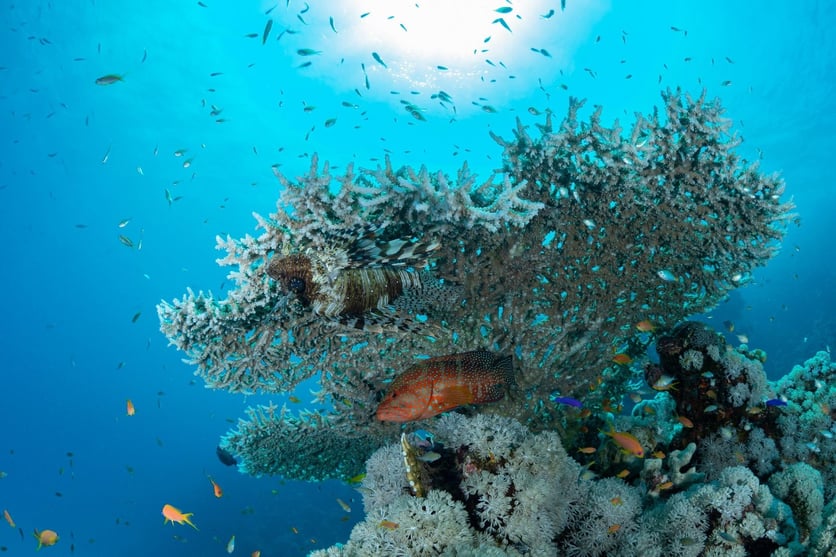
Coral reef in the red sea

Coral reef in the Red Sea

The Expedition to Investigate Deep Sea Depressions & Oxygen Dynamics in the Red Sea

Led by the National Center for Wildlife (NCW), the Saudi Arabian governmental agency responsible for biodiversity assessments, conservation strategy, and more in the region - including oversight of both terrestrial and aquatic environments - a team of expert scientists was assembled to investigate unexplored, deep waters in the Red Sea, which is bordered by Saudi Arabia along with Djibouti, Egypt, Eritrea, and Yemen. Shannon Klein, Ph.D., Research Scientist from King Abdullah University of Science and Technology (KAUST), and Dr. Larissa Frühe, Postdoctoral Associate from OceanX, led studies with a focus on eDNA and oxygen dynamics, alongside other leading experts.

The NCW was instrumental as a principal partner on this expedition: providing scientific resources, guidance, and expertise. Goals for this research were identified based on conservation and biological management interests as part of the Red Sea Decade Expedition.

KAUST provided scientific expertise by contributing multiple scientific working groups and access to laboratories with different specialties for this integrative research. OceanX focused on fostering its partnerships with regional scientists and institutions to map and characterize the seafloor onboard the R/V OceanXplorer – an 87 meter research vessel equipped with scientific labs for data collection and analyses as well as a media lab for editing photos and videos from their discoveries in real time. These critical collaborations helped advance oceanography and marine science, while equipping local experts with cutting-edge tools onboard and skills to drive long-term protection and sustainable use of the ocean.

OceanX is an impact-driven organization. The science we lead is designed to go beyond discovery. We want to place any critical knowledge we find in the field, directly in front of decision-makers to inform action, protect the ocean, and help build a more sustainable future for us all.”

- Kailani Acosta, Ph.D., Science Program Associate at OceanX

What began as a chance encounter with an unexpected pocket of low oxygen concentrations quickly turned into a larger scientific pursuit. While surveying the ocean floor of the Red Sea to investigate previously studied seafloor depressions, the team became particularly interested in deep depressions where oxygen levels were markedly depleted. This discovery prompted many questions about the biology, chemistry, and geology of these regions and the species that inhabit these extreme conditions. Led by Klein, the team addressed this work showcased in their 2025 PNAS Nexus study, Deep oxygen-depleted depressions in a Red Sea coral reef sustain resistant ecosystems. Drawing on patterns observed in other marine systems, they hypothesized that the deep structures and warm tropical environment would act to restrict vertical mixing to deplete dissolved oxygen. A second critical question followed: what processes set these systems in motion in the first place? Identifying the catalyst behind the formation and persistence of these low-oxygen depressions became central to understanding not only their physical dynamics, but also how life manages to endure within them.


The Power of Collaboration and the Red Sea Decade Expedition

The research was initiated and conducted as part of the Red Sea Decade Expedition, an initiative championed by NCW, to serve as the infrastructure to develop a clearer vision of the Red Sea’s environments. One of the main objectives of the Red Sea Decade Expedition was to conduct extensive research to generate data to identify areas of high biodiversity, fuel marine conservation policies, and better understand ecological relationships within the Red Sea.

Saudi Arabia aims to protect at least 30% of its land and seas by 2030, a target supported through the mandate of the NCW. This initiative is one amongst many from the Saudi Arabian government to propel Saudi Vision 2030 - a strategy aimed at investing in key sectors and supporting ambitious projects. The focus is to create a Saudi Arabia where, “tradition, innovation, and sustainability go hand-in-hand.”

With the Red Sea Decade Expedition as the impetus, this multi-organizational collaboration between the NCW, KAUST, and OceanX showcases the possibilities for discovery when government, academia, and research institutions come together to garner greater understanding of the natural world.

In addition to the primary partners, additional collaborators were involved to help make this research a success, including Beneath the Waves, King Abdul Aziz University, Ministry of Earth, Water and Agriculture, NEOM, NHK, Red Sea Global, and VICE News.


Methodology & Instrumentation

With the international, multi-disciplinary team aboard the R/V OceanXplorer, they began to map the area they were interested in researching, the Farasan Bank, to investigate deep depressions beneath the surface of shallow coral reefs. Using acoustic mapping alongside remotely operated vehicles (ROV) and submersibles, they began to put together a clearer picture of the seafloor of the Farasan Bank, specifically looking at the areas they suspected had depressions deep enough to contain ecosystems that are fundamentally different from those found above. They pinpointed two specific locations on the bank that they hoped to investigate.
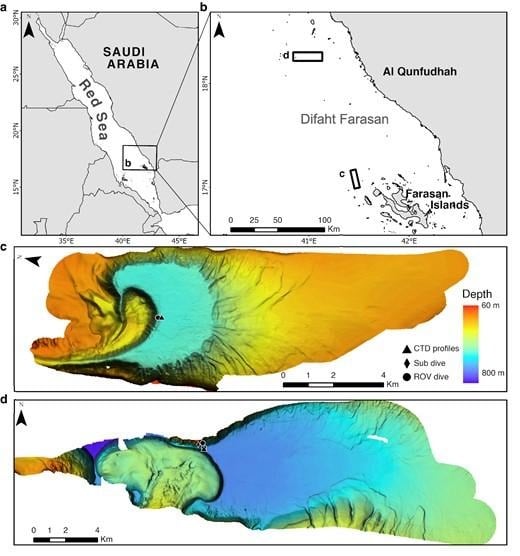
Fig. 1 (from Deep oxygen-depleted depressions in a Red Sea coral reef sustain resistant ecosystems 2025) Locations of the depressions in the Difaht Farasan and their structural features. a) Overview map of the Red Sea, highlighting the location of the Difaht Farasan. b) Map of the Difaht Farasan, the geological formation from which the Farasan Islands emerged. The positions of the depressions discussed in this work are marked. c and d) 20-m resolution bathymetry collected in March 2022 showing seafloor morphology of the two depressions (Farasan Deep and Amq Deep). The color scale ranges from 60- to 800-m depth, and the locations of Farasan Deep c) and Amq Deep d) are also shown in b). On the bathymetric maps, triangle symbols mark the location of the CTD casts, circles represent the ROV dives, and the diamond symbols denote the manned submersible dives. All assets were deployed at the deepest accessible points of the surveyed depressions.

The team was excited to find the previously documented locations were correct – they found numerous deep depressions beneath the surface waters of shallow reefs. With the exact locations of the coral reef depressions confirmed and the bathymetry maps created, they began to identify points of interest in which they would need to take samples to determine dissolved oxygen concentrations.
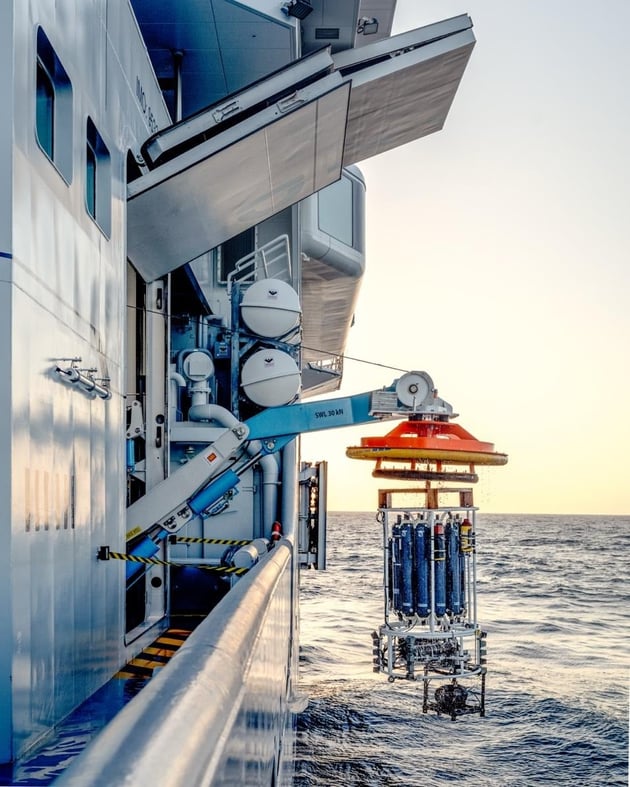
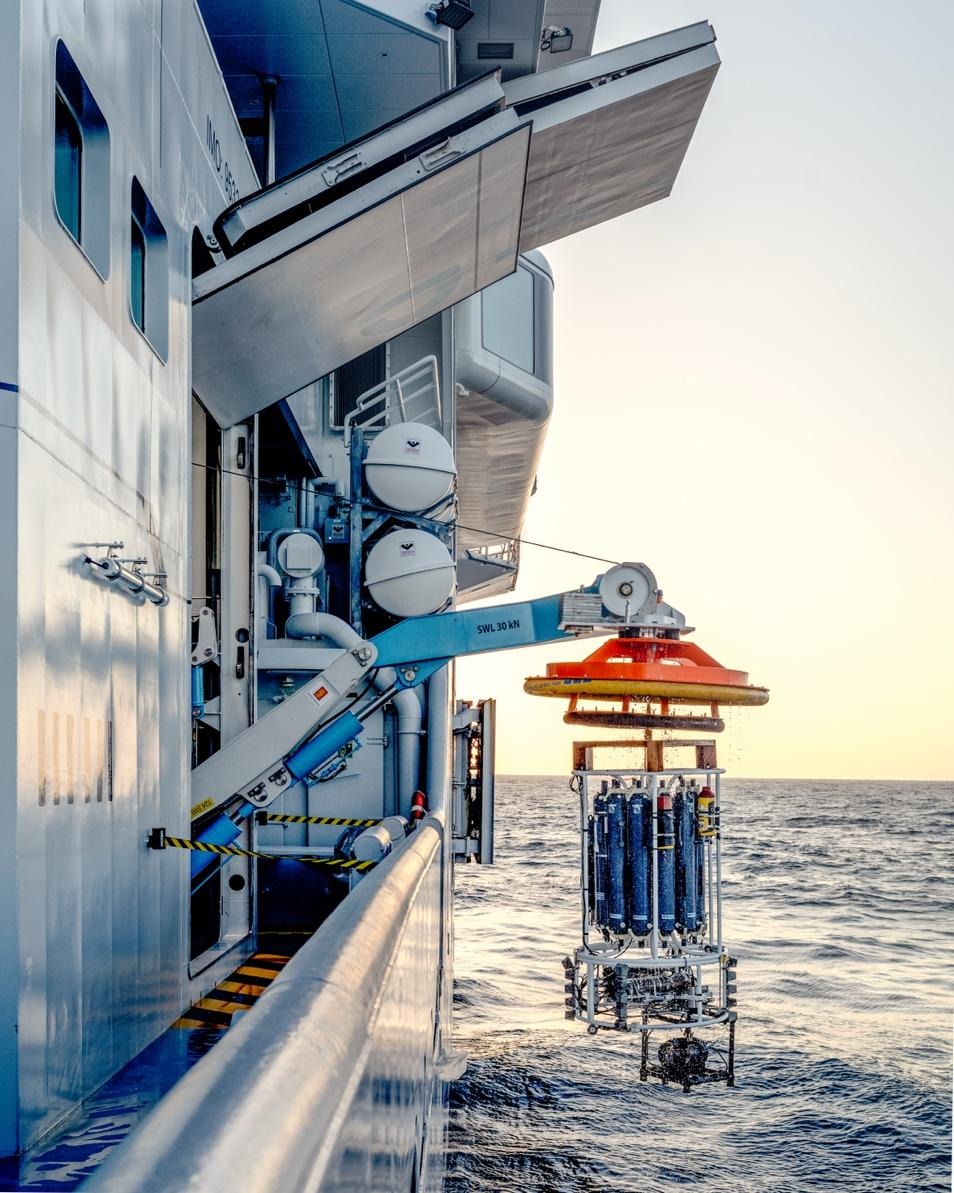
Photo courtesy of NCW and OceanX: Sea-Bird Scientific’s SBE 9/11plus CTD rosette profiler and SBE 43 oxygen sensor

Sea-Bird Scientific’s tried and trusted SBE 9/11plus CTD rosette profiler and SBE 43 oxygen sensor were chosen for this mission and deployed using an oceanic rosette system off the R/V OceanXplorer. Taking 143 profiles over the four and a half months of the expedition, including both up and down casts, the system was deployed at depths of up to 620 meters at the deepest profiling location in this study. Sea-Bird Scientific instrumentation was chosen as the primary profiling solution due to its high reliability and accuracy over time. According to Klein,

“...it’s incredibly important that we have reliable sensors with high accuracy. These sensors were incredibly stable going through the water column,”

and notes that limited fluctuation is key to stable measurements and defensible data.

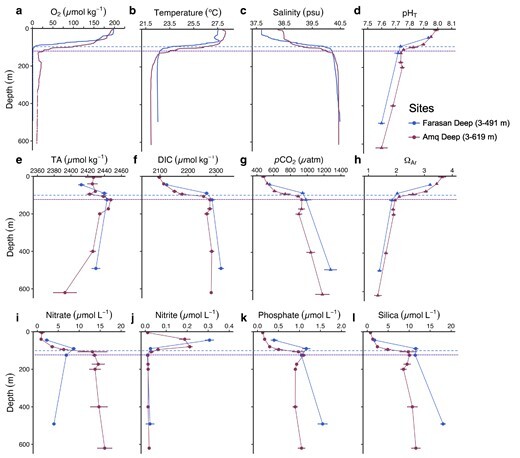
To validate the oxygen measurements, they used Winkler titrations, a method for measuring dissolved oxygen using chemical reactions, and found that the oxygen measurements from the SBE 43 performed better than the Winkler titrations at very low oxygen concentrations, emphasizing the criticality of both reliable instrumentation and data validation.
m_pgaf049f2

Fig. 2 (from Deep oxygen-depleted depressions in a Red Sea coral reef sustain resistant ecosystems 2025) Depth profiles of environmental parameters in the Farasan depressions. a–c) Full-depth profiles of dissolved oxygen concentrations, temperature, and salinity measured by the Sea-Bird Scientific CTD profiler (SBE 9/11plus), with oxygen (SBE 43) verified against the Winkler titration method at high oxygen levels. d–h) Profiles of measured (TA and DIC) and calculated (pHT, pCO2, and ΩAr) parameters of the seawater carbonate system. i–l) Depth profiles of measured concentrations of inorganic nutrients. d–l) Parameters measured in discrete water samples from Niskin bottles. Blue lines and dots represent data collected at Farasan Deep (from 3 to 491 m), whereas data collected at Amq Deep (3–619 m) are indicated by purple lines and dots. a–l) Dashed lines represent the approximate depth of the carbon maximum zones. Error bars represent ±1 SD.

Results: Life Thrives in Low Oxygen

One of the main objectives of this research was to better understand what drives the formation of persistent low oxygen zones in the tropics, such as those observed in the Red Sea. The team of interdisciplinary experts aboard the R/V OceanXplorer found no evidence that these oxygen depleted zones in the Red Sea were from anthropogenic influences.

When thinking about oxygen depletion zones, one would initially hypothesize that life does not thrive in low oxygen extremes, but what the team found was contrary to this hypothesis. Klein shares,

“..one of the most surprising angles of the study is that we found diverse marine life living in these warm, oxygen depleted zones.”

The team was excited to share one of their most surprising discoveries: lanternfish in this region had developed a behavioral adaptation that enabled them to persist in low oxygen environments by slowing down their swimming speed. The team believes this is a method to preserve energy and oxygen usage to enhance chances of survival. The team also found another behavioral adaptation of the lanternfish – it can exist in these low-level oxygen conditions at the high temperatures of 22 degrees Celsius, while in other regions, fish survive at similar oxygen levels but at much cooler temperatures, which reduces their requirements for oxygen.
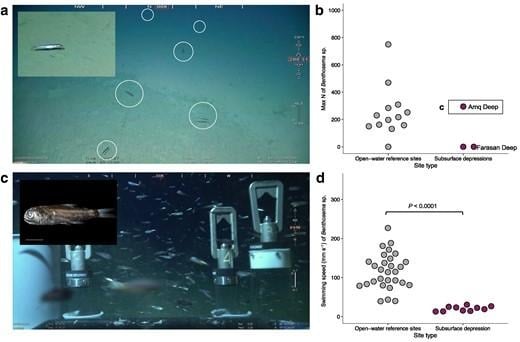
Fig. 3 (from Deep oxygen-depleted depressions in a Red Sea coral reef sustain resistant ecosystems 2025). High-density lanternfish (Benthosema sp.) aggregation exhibits behavioral adaptations in stable suboxic conditions. a) Small aggregation (up to six individuals frame−1) of an unidentified cryptobenthic fish in Farasan Deep (at 286-m water depth, <2 µmol O2 kg−1). b) Comparison of the maximum number of lanternfish (Benthosema sp.) observed in any single video frame (Max N) of ROV footage between 13 open-water reference sites and Farasan Deep and Amq Deep. c) Large aggregation (up to 295 individuals frame−1) of Benthosema sp. observed in Farasan Deep under suboxic conditions (10.9 µmol O2 kg−1) at 619-m water depth. Inset: microscope image of a Benthosema sp. specimen (scale bar: 1 cm). d) Comparison of estimated swimming speeds of Benthosema sp. individuals in the reference sites (n = 29 individuals) and Amq Deep (n = 10 individuals), where Benthosema sp. aggregations were observed. a, c) Image credit: the National Center of Wildlife (NCW, Kingdom of Saudi Arabia).

While life was diverse in these oxygen deprived environments, the team notes that as soon as oxygen levels increased further up the water column, so did the diversity of organisms.

Furthermore, the team found that the two study sites, separated by several hundreds of kilometers, exhibited different degrees of oxygen depletion due to differences in their geomorphology. At one of the sites, the SBE 43 oxygen sensors could not detect any oxygen, while at the second observed site, the sensor could detect very low levels of oxygen indicating a suboxic environment. Klein goes on to describe the conditions that make up a suboxic environment as a place that contains,

“...oxygen concentrations that are obviously detectable, but very restrictive or in theory should be very restrictive of marine life at such warm temperatures.”
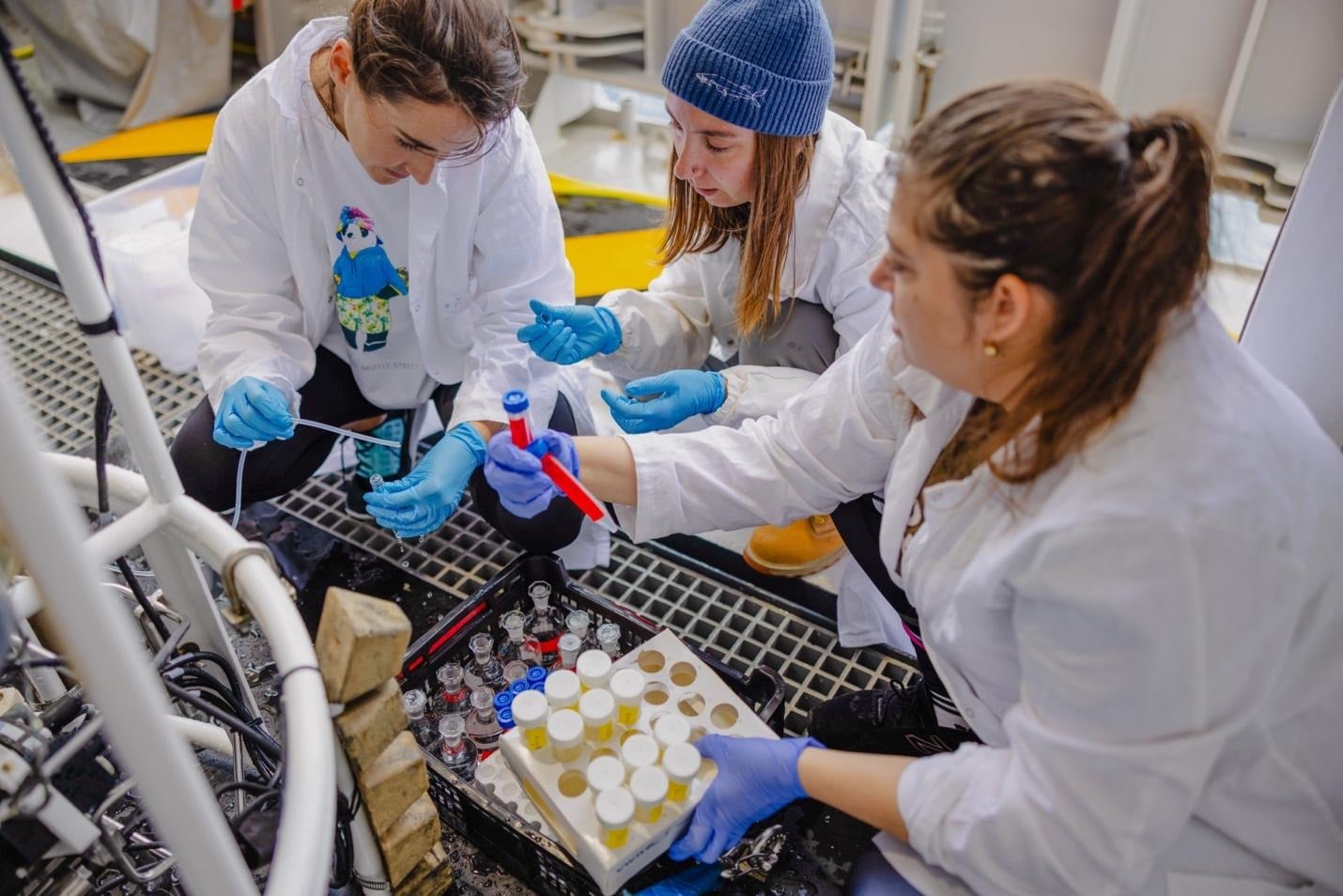
Photo courtesy of NCW and OceanX: Klein, Frühe, Parry (all authors of the study) taking water samples from the CTD rosette system for oxygen and nutrient analysis.

Dr. Larissa Frühe, a Postdoctoral Associate at OceanX who specializes in molecular ecology and marine microbiology, draws attention to the changes in oxygen levels alongside the variation in biological diversity. She notes,

“...[the variation] makes it even more interesting to see that we got persistently low or zero oxygen in areas so close to a highly diverse coral ecosystem.”

The variety of organisms found in these unsuspecting areas highlights the importance of ecosystems in these oxygen depleted zones for biodiversity and provides a basis for increased conservation and policy to protect these fragile environments.

Furthermore, accumulation of nitrate, phosphate, and silica at the bottom of these depressions show similar concentrations to those found in other oxygen minimum areas around the globe. According to Frühe, this specific variety of nutrient concentrations typically indicate metabolic processes that break down organic matter, which rains down through the water column as ‘marine snow’ and eventually deposits on the seafloor. These metabolic breakdowns change the nutrient profile when all of this organic matter accumulates in a specific spot. While this sounds like it could upset the nutrient profile balance, Frühe notes that it can create a sort-of micro niche environment - where specific microbes that survive on those particular types of nutrients can thrive. Frühe was excited to share that it is,

“...really interesting to see how the community of the microbes changes throughout the water column following the changes in the nutrients and organic matter, kind of like a biological gradient that we can see.”

These observations demonstrate the nature of environmental feedback – the decomposition of organic matter can contribute to the thriving of other organisms. She notes an example of an organism not particularly liking a low oxygen environment, but thriving with the nutrients present there, which continues to emphasize the variability in inputs needed for a successful ecosystem.


Implications for the Future of Marine Conservation & Future Research

This research demonstrates the specific adaptations organisms have developed to be able to thrive in the oxygen depleted zones discovered in the Red Sea. According to Klein, naturally occurring sources of nutrients and elevated temperatures are the two main drivers that can change these ecosystems quickly and therefore will need to be monitored to understand potential changes to the biota.

The findings that these unique organisms can thrive in oxygen deprived environments can now be included as part of the NCW and overall Saudi Arabian conservation strategy as part of the Red Sea Decade Expedition. As Klein notes,

“...the NCW has expanded marine protected areas to include these sites and will also keep an eye on how these sites might change over time.”

These observations will help characterize the findings of the Red Sea Decade Expedition and inform future policy with the backing of defensible data as it relates to marine management and conservation.

Not only do findings related to biodiversity help characterize a specific region; it also helps to inform what other regions with similar geomorphology and ecosystems may experience. The team notes that the transdisciplinary nature of this research enabled the team to truly garner a holistic picture as to the dynamics of these Red Sea locations through varying areas of expertise and types of data gathered. It is through international collaboration and partnership, such as between NCW, KAUST, OceanX, and more, that enables these ground-breaking discoveries to be made.

Sea-Bird Scientific greatly appreciates the collaboration and partnership of NCW, KAUST, and OceanX to make this feature come to life.


 

Summary

This highlight was developed in partnership with NCW, KAUST, and OceanX, to showcase the research done as part of a scientific article released in March of 2025 in PNAS Nexus:

Deep oxygen-depleted depressions in a Red Sea coral reef sustain resistant ecosystems

The teams involved in this expedition used instrumentation from Sea-Bird Scientific to help characterize oxygen depletion zones in the Red Sea: the SBE 9/11plus and SBE 43 oxygen sensor.

Instruments and equipment used in this case study:

  • Sea-Bird Scientific’s SBE 9/11plus CTD rosette
  • Sea-Bird Scientific’s SBE 43 oxygen sensor
  • Acoustic mapping systems for bathymetry data collection
  • Remotely operated vehicle (ROV) and submersibles for footage and physical sample collection
  • Winkler titrations for confirming oxygen measurements

Customers highlighted in this research:

Additional partners:


The authors of the original scientific article thank the above-mentioned participants for the invitation to participate in the RSDE22. The authors thank the teams of the R/V OceanXplorer for their operational and logistical support during the expedition. All data and images collected during the RSDE22 are credited to OceanX and the NCW. The authors also thank J.P. Gattuso, Y. Khaled, C. Roch, V. Dighe, V. Dasari, C. Fu, and staff from the Coastal Marine Resources Core Lab of KAUST for their expert advice and technical support.

1 | Danovaro R, Corinaldesi C, Dell’Anno A, Snelgrove PV. 2017. The deep-sea under global change. Curr Biol. 27:R461–R465.

Google Scholar

CrossrefPubMed

WorldCat

2 | Levin LA, et al. 2019. Global observing needs in the deep ocean. Front Mar Sci. 6:a241.

Google Scholar

Crossref

WorldCat

3 | Dunn DC, et al. 2018. A strategy for the conservation of biodiversity on mid-ocean ridges from deep-sea mining. Sci Adv. 4:eaar4313.

Google Scholar

CrossrefPubMed

WorldCat

4 | Sakellariou D, Rousakis G, Panagiotopoulos I, Morfis I, Bailey GN. Geological structure and late quaternary geomorphological evolution of the Farasan islands continental shelf, south Red Sea, SW Saudi Arabia. In: Rasul N, Stewart I, editors. Geological setting, palaeoenvironment and archaeology of the Red Sea. Springer, 2019. p. 629–652.

Google Scholar

Crossref

Google Preview

WorldCat

COPAC

5 | Petrovic A, et al. 2023. Fragmentation, rafting, and drowning of a carbonate platform margin in a rift-basin setting. Geology. 51:242–246.

Google Scholar

Crossref

WorldCat

6 | Bastos AC, et al. 2013. Buracas: novel and unusual sinkhole-like features in the Abrolhos Bank. Cont Shelf Res. 70:118–125.

Google Scholar

Crossref

WorldCat

7 | Purkis S, et al. 2014. Large-scale carbonate platform development of Cay Sal Bank, Bahamas, and implications for associated reef geomorphology. Geomorphology. 222:25–38.

Google Scholar

Crossref

WorldCat

8 | van Hengstum PJ, Scott DB, Gröcke DR, Charette MA. 2011. Sea level controls sedimentation and environments in coastal caves and sinkholes. Mar Geol. 286:35–50.

Google Scholar

Crossref

WorldCat

9 | Betzler C, et al. 2015. The leaking bucket of a Maldives atoll: implications for the understanding of carbonate platform drowning. Mar Geol. 366:16–33.

Google Scholar

Crossref

WorldCat

10 | Dullo W-C, Montaggioni L. Modern Red Sea coral reefs: a review of their morphologies and zonation. Sedimentation and tectonics in rift basins Red Sea:-Gulf of Aden. Springer, Dordrecht, 1998. p. 583–594.

Google Scholar

Crossref

Google Preview

WorldCat

COPAC


11 | Ali M, et al. 2023. Geometry and kinematics of the Middle to Late Miocene salt tectonics, central Egyptian Red Sea margin. J Struct Geol. 176:104955.

Google Scholar

Crossref

WorldCat

12 | Rabalais N, et al. 2010. Dynamics and distribution of natural and human-caused hypoxia. Biogeosciences. 7:585–619.

Google Scholar

Crossref

WorldCat

13 | Astor Y, Muller-Karger F, Scranton MI. 2003. Seasonal and interannual variation in the hydrography of the Cariaco Basin: implications for basin ventilation. Cont Shelf Res. 23:125–144.

Google Scholar

Crossref

WorldCat

14 | Chamalaki A, et al. 2014. Bacterial diversity and hydrography of Etoliko, an anoxic semi-enclosed coastal basin in Western Greece. Ann Microbiol. 64:661–670.

Google Scholar

Crossref

WorldCat

15 Glazer BT, et al. 2006. Spatial and temporal variability of the Black Sea suboxic zone. Deep Sea Res 2 Top Stud Oceanogr. 53:1756–1768.

Google Scholar

Crossref

WorldCat

16 | Bantan R. Geology and sedimentary environments of Farasan Bank (Saudi Arabia) southern Red Sea: a combined remote sensing and field study. University of London, 1999. p. 1–212.

Google Scholar

Google Preview

WorldCat

COPAC


17 | Cousteau JY, Dugan J. “Chapter 3: Red Sea and green reef” in the living sea. Harper and Row Publishers, New York/Evanston, USA, 1963, pp. 32–47.

Google Scholar

Google Preview

WorldCat

COPAC

18 | Diaz RJ, Rosenberg R. 2008. Spreading dead zones and consequences for marine ecosystems. Science. 321:926–929.

Google Scholar

CrossrefPubMed

WorldCat

19 | Doney SC. 2010. The growing human footprint on coastal and open-ocean biogeochemistry. Science. 328:1512–1516.

Google Scholar

CrossrefPubMed

WorldCat

20 | Gilbert D, Rabalais N, Diaz R, Zhang J. 2010. Evidence for greater oxygen decline rates in the coastal ocean than in the open ocean. Biogeosciences. 7:2283–2296.

Google Scholar

Crossref

WorldCat

21 | DeCarlo TM, et al. 2020. Nutrient-supplying ocean currents modulate coral bleaching susceptibility. Sci Adv. 6:eabc5493.

Google Scholar

CrossrefPubMed

WorldCat

22 | Churchill JH, Bower AS, McCorkle DC, Abualnaja Y. 2014. The transport of nutrient-rich Indian Ocean water through the Red Sea and into coastal reef systems. J Mar Res. 72:165–181.

Google Scholar

Crossref

WorldCat

23 | Altieri AH, Johnson MD, Swaminathan SD, Nelson HR, Gedan KB. 2021. Resilience of tropical ecosystems to ocean deoxygenation. Trends Ecol Evol. 36:227–238.

Google Scholar

CrossrefPubMed

WorldCat

24 | Hughes DJ, et al. 2020. Coral reef survival under accelerating ocean deoxygenation. Nat Clim Chang. 10:296–307.

Google Scholar

Crossref

WorldCat

25 | Limburg KE, Breitburg D, Swaney DP, Jacinto G. 2020. Ocean deoxygenation: a primer. One Earth. 2:24–29.

Google Scholar

Crossref

WorldCat

26 | Avendaño-Alvarez O, Salas-Monreal D, Marin-Hernandez M, Salas-de-Leon DA, Monreal-Gomez MA. 2017. Annual hydrological variation and hypoxic zone in a tropical coral reef system. Reg Stud Mar Sci. 9:145–155.

Google Scholar

WorldCat

27 | Altieri AH, et al. 2017. Tropical dead zones and mass mortalities on coral reefs. Proc Natl Acad Sci U S A. 114:3660–3665.

Google Scholar

CrossrefPubMed

WorldCat

28 | Johnson MD, Rodriguez LM, Altieri AH. 2018. Shallow-water hypoxia and mass mortality on a Caribbean coral reef. Bull Mar Sci. 94:143–144.

Google Scholar

Crossref

WorldCat

29 | Johnson MD, et al. 2021. Rapid ecosystem-scale consequences of acute deoxygenation on a Caribbean coral reef. Nat Commun. 12:4522.

Google Scholar

CrossrefPubMed

WorldCat

30 | Naqvi SWA. 2021. Deoxygenation in marginal seas of the Indian Ocean. Front Mar Sci. 8:624322.

Google Scholar

Crossref

WorldCat

31 | Ali EB. The inorganic carbon cycle of the Red Sea. The University of Bergen, 2017. p. 1–22.

Google Scholar

Google Preview

WorldCat

COPAC


32 | Paulmier A, Ruiz-Pino D, Garçon V. 2011. CO2 maximum in the oxygen minimum zone (OMZ). Biogeosciences. 8:239–252.

Google Scholar

Crossref

WorldCat

33 | Cai W-J, et al. 2011. Acidification of subsurface coastal waters enhanced by eutrophication. Nat Geosci. 4:766–770.

Google Scholar

Crossref

WorldCat

34 | Steiner Z, Turchyn AV, Harpaz E, Silverman J. 2018. Water chemistry reveals a significant decline in coral calcification rates in the southern Red Sea. Nat Commun. 9:3615.

Google Scholar

CrossrefPubMed

WorldCat

35 | Baldry K, et al. 2020. Anomalies in the carbonate system of Red Sea coastal habitats. Biogeosciences. 17:423–439.

Google Scholar

Crossref

WorldCat

36 | Roder C, et al. 2013. First biological measurements of deep-sea corals from the Red Sea. Sci Rep. 3:2802.

Google Scholar

CrossrefPubMed

WorldCat

37 | Thamdrup B, Dalsgaard T, Revsbech NP. 2012. Widespread functional anoxia in the oxygen minimum zone of the Eastern South Pacific. Deep Sea Res 1 Oceanogr Res Pap. 65:36–45.

Google Scholar

Crossref

WorldCat

38 | Tiano L, et al. 2014. Oxygen distribution and aerobic respiration in the north and southeastern tropical Pacific oxygen minimum zones. Deep Sea Res 1 Oceanogr Res Pap. 94:173–183.

Google Scholar

Crossref

WorldCat

39 | Ganesh S, et al. 2018. Single cell genomic and transcriptomic evidence for the use of alternative nitrogen substrates by anammox bacteria. ISME J. 12:2706–2722.

Google Scholar

CrossrefPubMed

WorldCat

40 | Farrenkopf AM, Luther Iii GW. 2002. Iodine chemistry reflects productivity and denitrification in the Arabian Sea: evidence for flux of dissolved species from sediments of western India into the OMZ. Deep Sea Res 2 Top Stud Oceanogr. 49:2303–2318.

Google Scholar

Crossref

WorldCat

41 | Bristow LA, et al. 2016. Ammonium and nitrite oxidation at nanomolar oxygen concentrations in oxygen minimum zone waters. Proc Natl Acad Sci U S A. 113:10601–10606.

Google Scholar

CrossrefPubMed

WorldCat

42 | Peng X, et al. 2016. Revisiting nitrification in the Eastern Tropical South Pacific: a focus on controls. J Geophys Res Oceans. 121:1667–1684.

Google Scholar

Crossref

WorldCat

43 | Kalvelage T, et al. 2011. Oxygen sensitivity of anammox and coupled N-cycle processes in oxygen minimum zones. PLoS One. 6:e29299.

Google Scholar

CrossrefPubMed

WorldCat

44 | Callahan BJ, et al. 2016. DADA2: high-resolution sample inference from Illumina amplicon data. Nat Methods. 13:581–583.

Google Scholar

CrossrefPubMed

WorldCat

45 | Quast C, et al. 2013. The SILVA ribosomal RNA gene database project: improved data processing and web-based tools. Nucleic Acids Res. 41:D590–D596.

Google Scholar

CrossrefPubMed

WorldCat

46 | Beman JM, Carolan MT. 2013. Deoxygenation alters bacterial diversity and community composition in the ocean's largest oxygen minimum zone. Nat Commun. 4:2705.

Google Scholar

CrossrefPubMed

WorldCat

47 | Stevens H, Ulloa O. 2008. Bacterial diversity in the oxygen minimum zone of the eastern tropical South Pacific. Environ Microbiol. 10:1244–1259.

Google Scholar

CrossrefPubMed

WorldCat

48 | Yeh Y-C, Fuhrman JA. 2022. Contrasting diversity patterns of prokaryotes and protists over time and depth at the San-Pedro Ocean Time series. ISME Commun. 2:36.

Google Scholar

CrossrefPubMed

WorldCat

49 | Parris DJ, Ganesh S, Edgcomb VP, DeLong EF, Stewart FJ. 2014. Microbial eukaryote diversity in the marine oxygen minimum zone off northern Chile. Front Microbiol. 5:543.

Google Scholar

CrossrefPubMed

WorldCat

50 | Orsi W, Song YC, Hallam S, Edgcomb V. 2012. Effect of oxygen minimum zone formation on communities of marine protists. ISME J. 6:1586–1601.

Google Scholar

CrossrefPubMed

WorldCat

51 | Jessen GL, et al. 2017. Hypoxia causes preservation of labile organic matter and changes seafloor microbial community composition (Black Sea). Sci Adv. 3:e1601897.

Google Scholar

CrossrefPubMed

WorldCat

52 | Sohm JA, et al. 2016. Co-occurring Synechococcus ecotypes occupy four major oceanic regimes defined by temperature, macronutrients and iron. ISME J. 10:333–345.

Google Scholar

CrossrefPubMed

WorldCat

53 | Coello-Camba A, et al. 2020. Picocyanobacteria community and cyanophage infection responses to nutrient enrichment in a mesocosms experiment in oligotrophic waters. Front Microbiol. 11:1153.

Google Scholar

CrossrefPubMed

WorldCat

54 | Pearman JK, Kürten S, Sarma YVB, Jones BH, Carvalho S. 2016. Biodiversity patterns of plankton assemblages at the extremes of the Red Sea. FEMS Microbiol Ecol. 92:fiw002.

Google Scholar

CrossrefPubMed

WorldCat

55 | Qian P-Y, et al. 2011. Vertical stratification of microbial communities in the Red Sea revealed by 16S rDNA pyrosequencing. ISME J. 5:507–518.

Google Scholar

CrossrefPubMed

WorldCat

56 | McKew BA, Dumbrell AJ, Taylor JD, McGenity TJ, Underwood GJ. 2013. Differences between aerobic and anaerobic degradation of microphytobenthic biofilm-derived organic matter within intertidal sediments. FEMS Microbiol Ecol. 84:495–509.

Google Scholar

CrossrefPubMed

WorldCat

57 | Bernardet J-F, Bowman JP. 2006. The genus flavobacterium. The Prokaryotes. 7:481–531.

Google Scholar

WorldCat

58 | Sun X, et al. 2019. Uncultured Nitrospina-like species are major nitrite oxidizing bacteria in oxygen minimum zones. ISME J. 13:2391–2402.

Google Scholar

CrossrefPubMed

WorldCat

59 | Pachiadaki MG, et al. 2017. Major role of nitrite-oxidizing bacteria in dark ocean carbon fixation. Science. 358:1046–1051.

Google Scholar

CrossrefPubMed

WorldCat

60 | Kniemeyer O, et al. 2007. Anaerobic oxidation of short-chain hydrocarbons by marine sulphate-reducing bacteria. Nature. 449:898–901.

Google Scholar

CrossrefPubMed

WorldCat

61 | Watanabe M, Higashioka Y, Kojima H, Fukui M. 2017. Desulfosarcina widdelii sp. nov. and Desulfosarcina alkanivorans sp. nov., hydrocarbon-degrading sulfate-reducing bacteria isolated from marine sediment and emended description of the genus Desulfosarcina. Int J Syst Evol Microbiol. 67:2994–2997.

Google Scholar

CrossrefPubMed

WorldCat

62 | Ganesh S, et al. 2015. Size-fraction partitioning of community gene transcription and nitrogen metabolism in a marine oxygen minimum zone. ISME J. 9:2682–2696.

Google Scholar

CrossrefPubMed

WorldCat

63 | Suter EA, Pachiadaki M, Taylor GT, Astor Y, Edgcomb VP. 2018. Free-living chemoautotrophic and particle-attached heterotrophic prokaryotes dominate microbial assemblages along a pelagic redox gradient. Environ Microbiol. 20:693–712.

Google Scholar

CrossrefPubMed

WorldCat

64 | Seymour CO, et al. 2023. Hyperactive nanobacteria with host-dependent traits pervade Omnitrophota. Nat Microbiol. 8:727–744.

Google Scholar

CrossrefPubMed

WorldCat

65 | Guillou L, et al. 2008. Widespread occurrence and genetic diversity of marine parasitoids belonging to Syndiniales (Alveolata). Environ Microbiol. 10:3349–3365.

Google Scholar

CrossrefPubMed

WorldCat

66 | Suter EA, Pachiadaki M, Taylor GT, Edgcomb VP. 2021. Eukaryotic parasites are integral to a productive microbial food web in oxygen-depleted waters. Front Microbiol. 12:764605.

Google Scholar

CrossrefPubMed

WorldCat

67 | Montagnes DJ, Chambouvet A, Guillou L, Fenton A. 2008. Responsibility of microzooplankton and parasite pressure for the demise of toxic dinoflagellate blooms. Aquat Microb Ecol. 53:211–225.

Google Scholar

Crossref

WorldCat

68 | Lange M, et al. 1996. Identification of the class Prymnesiophyceae and the genus Phaeocystis with ribosomal RNA-targeted nucleic acid probes detected by flow cytometry. J Phycol. 32:858–868.

Google Scholar

Crossref

WorldCat

69 | Koppelle S, et al. 2022. Mixotrophy in the bloom-forming genus Phaeocystis and other haptophytes. Harmful Algae. 117:102292.

Google Scholar

CrossrefPubMed

WorldCat

70 | Tikhonenkov DV, et al. 2022. On the origin of TSAR: morphology, diversity and phylogeny of Telonemia. Open Biol. 12:210325.

Google Scholar

CrossrefPubMed

WorldCat

71 | Dypvik E, Kaartvedt S. 2013. Vertical migration and diel feeding periodicity of the skinnycheek lanternfish (Benthosema pterotum) in the Red Sea. Deep Sea Res 1 Oceanogr Res Pap. 72:9–16.

Google Scholar

Crossref

WorldCat

72 | Kaartvedt S, Røstad A, Klevjer TA. 2009. Sprat Sprattus sprattus can exploit low oxygen waters for overwintering. Mar Ecol Prog Ser. 390:237–249.

Google Scholar

Crossref

WorldCat

73 | Utne-Palm AC, et al. 2010. Trophic structure and community stability in an overfished ecosystem. Science. 329:333–336.

Google Scholar

CrossrefPubMed

WorldCat

74 | Vaquer-Sunyer R, Duarte CM. 2008. Thresholds of hypoxia for marine biodiversity. Proc Natl Acad Sci U S A. 105:15452–15457.

Google Scholar

CrossrefPubMed

WorldCat

75 | Gallo ND, Levin LA, Beckwith M, Barry JP. 2019. Home sweet suboxic home: remarkable hypoxia tolerance in two demersal fish species in the Gulf of California. Ecology. 100:e02539.

Google Scholar

CrossrefPubMed

WorldCat

76 | Gallo ND, Levin LA. Chapter three—fish ecology and evolution in the World's Oxygen Minimum zones and implications of ocean deoxygenation. In: Curry BE, editors. Advances in marine biology. Academic Press, 2016. vol. 74. p. 117–198.

Google Scholar

Google Preview

WorldCat

COPAC


77 | Guinotte JM, et al. 2006. Will human-induced changes in seawater chemistry alter the distribution of deep-sea scleractinian corals? Front Ecol Environ. 4:141–146.

Google Scholar

Crossref

WorldCat

78 | Bertagnolli AD, Stewart FJ. 2018. Microbial niches in marine oxygen minimum zones. Nat Rev Microbiol. 16:723–729.

Google Scholar

CrossrefPubMed

WorldCat

79 | Wright JJ, Konwar KM, Hallam SJ. 2012. Microbial ecology of expanding oxygen minimum zones. Nat Rev Microbiol. 10:381–394.

Google Scholar

CrossrefPubMed

WorldCat

80 | Pörtner H.-O. 2012. Integrating climate-related stressor effects on marine organisms: unifying principles linking molecule to ecosystem-level changes. Mar Ecol Prog Ser. 470:273–290.

Google Scholar

Crossref

WorldCat

81 | Micaroni V, et al. 2022. Adaptive strategies of sponges to deoxygenated oceans. Glob Chang Biol. 28:1972–1989.

Google Scholar

CrossrefPubMed

WorldCat

82 | Bell JJ, Bennett HM, Rovellini A, Webster NS. 2018. Sponges to be winners under near-future climate scenarios. BioScience. 68:955–968.

Google Scholar

Crossref

WorldCat

83 | Smith AM, Berman J, Key MM, Winter DJ. 2013. Not all sponges will thrive in a high-CO2 ocean: review of the mineralogy of calcifying sponges. Palaeogeogr Palaeoclimatol Palaeoecol. 392:463–472.

Google Scholar

Crossref

WorldCat

84 | Stewart JA, Strawson I, Kershaw J, Robinson LF. 2022. Stylasterid corals build aragonite skeletons in undersaturated water despite low pH at the site of calcification. Sci Rep. 12:13105.

Google Scholar

CrossrefPubMed

WorldCat

85 | Brown D, Edmunds PJ. 2016. Differences in the responses of three scleractinians and the hydrocoral Millepora platyphylla to ocean acidification. Mar Biol. 163:62.

Google Scholar

Crossref

WorldCat

86 | Oschlies A, Brandt P, Stramma L, Schmidtko S. 2018. Drivers and mechanisms of ocean deoxygenation. Nat Geosci. 11:467–473.

Google Scholar

Crossref

WorldCat

87 | Dreano D, Raitsos DE, Gittings J, Krokos G, Hoteit I. 2016. The Gulf of Aden intermediate water intrusion regulates the southern Red Sea summer phytoplankton blooms. PLoS One. 11:e0168440.

Google Scholar

CrossrefPubMed

WorldCat

88 | Breitburg D, et al. 2018. Declining oxygen in the global ocean and coastal waters. Science. 359:eaam7240.

Google Scholar

CrossrefPubMed

WorldCat

89 | S. G. Klein et al. , Data from: Deep oxygen-depleted Red Sea coral reef depressions sustain resistant ecosystems. Dryad. 10.5061/dryad.9w0vt4bq4. Deposited 12 January 2025.


90 | Atamanchuk D, Koelling J, Send U, Wallace DWR. 2020. Rapid transfer of oxygen to the deep ocean mediated by bubbles. Nat Geosci. 13:232–237.

Google Scholar

Crossref

WorldCat

91 | Bittig HC, Fiedler B, Scholz R, Krahmann G, Körtzinger A. 2014. Time response of oxygen optodes on profiling platforms and its dependence on flow speed and temperature. Limnol Oceanogr Methods. 12:617–636.

Google Scholar

Crossref

WorldCat

92 | Kwiecinski JV, Babbin AR. 2021. A high-resolution atlas of the eastern tropical Pacific oxygen deficient zones. Global Biogeochem Cycles. 35:e2021GB007001.

Google Scholar

Crossref

WorldCat

93 | Dickson AG. 1994. Determination of dissolved oxygen in sea water by Winkler titration. WOCE Operations Manual, Part 3.1.3 Operations and Methods. WHP Office Report WHPO 91-1. WOCE Report No. 68/91, Revision 1 (Joyce TM, editor) Woods Hole (MA): WOCE Hydrographic Programme Office). p. 1–13. https://cchdo.github.io/hdo-assets/documentation/manuals/pdf/91_1/dickson2.pdf.


94 | Garcia-Robledo E, Paulmier A, Borisov SM, Revsbech NP. 2021. Sampling in low oxygenaquatic environments: the deviation from anoxic conditions. Limnol Oceanogr Methods. 19:733–740.

Google Scholar

Crossref

WorldCat

95 | Grasshoff K, Ehrhardt M, Kremling K. In: Grasshoff K, editors. Methods of seawater analysis. 3rd edn. Wiley-VCH Verlag, Weinheim, 1999. p. 1–532.

Google Scholar

Crossref

Google Preview

WorldCat

COPAC


96 | A. G. Dickson, C. L. Sabine, J. R. Christian (Eds), Guide to best practices for ocean CO2 measurements in PICES Special Publication. North Pacific Marine Science Organization, 2007. pp. 1–191.

Google Scholar

Google Preview

WorldCat

COPAC


97 | Gattuso JP, et al. 2023. Package ‘seacarb’: seawater carbonate chemistry. R Development Core Team. [accessed 2024 Jun 1]. https://cran.r-project.org/web/packages/seacarb/index.html


98 | Lueker TJ, Dickson AG, Keeling CD. 2000. Ocean pCO2 calculated from dissolved inorganic carbon, alkalinity, and equations for K1 and K2: validation based on laboratory measurements of CO2 in gas and seawater at equilibrium. Mar Chem. 70:105–119.

Google Scholar

Crossref

WorldCat

99 | Dickson A, Riley J. 1979. The estimation of acid dissociation constants in seawater media from potentionmetric titrations with strong base. Mar Chem. 7:89–99.

Google Scholar

Crossref

WorldCat

100 | Dickson AG. 1990. Standard potential of the reaction: AgCl (s)+ 12H2 (g)= Ag (s)+ HCl (aq), and the standard acidity constant of the ion HSO4− in synthetic sea water from 273.15 to 318.15 K. J Chem Thermodyn. 22:113–127.

Google Scholar

Crossref

WorldCat

101 | Herlemann DPR, et al. 2011. Transitions in bacterial communities along the 2000 km salinity gradient of the Baltic Sea. ISME J. 5:1571–1579.

Google Scholar

CrossrefPubMed

WorldCat

102 | Piredda R, et al. 2017. Diversity and temporal patterns of planktonic protist assemblages at a Mediterranean long term ecological research site. FEMS Microbiol Ecol. 93:fiw200.

Google Scholar

CrossrefPubMed

WorldCat

103 | Martin M. 2011. Cutadapt removes adapter sequences from high-throughput sequencing reads. EMBnet J. 17:10–12.

Google Scholar

Crossref

WorldCat

104 | Guillou L, et al. 2013. The protist ribosomal reference database (PR2): a catalog of unicellular eukaryote small sub-unit rRNA sequences with curated taxonomy. Nucleic Acids Res. 41:D597–D604.

Google Scholar

CrossrefPubMed

WorldCat

105 | Davis NM, Proctor DM, Holmes SP, Relman DA, Callahan BJ. 2018. Simple statistical identification and removal of contaminant sequences in marker-gene and metagenomics data. Microbiome. 6:226.

Google Scholar

CrossrefPubMed

WorldCat

106 | R. D. C. Team. R: a language and environment for statistical computing. R Foundation for Statistical Computing, Vienna, Austria, 2014.

Google Scholar

Google Preview

WorldCat

COPAC


107 | Nolan MKB, et al. 2024. Habitat suitability models reveal extensive distribution of deep warm-water coral frameworks in the Red Sea. Commun Earth Environ. 5:709.

Google Scholar

Crossref

WorldCat

108 | Gilby BL, et al. 2018. Seagrass meadows shape fish assemblages across estuarine seascapes. Mar Ecol Prog Ser. 588:179–189.

Google Scholar

Crossref

WorldCat

109 | Wee LK, Chew C, Goh GH, Tan S, Lee TL. 2012. Using Tracker as a pedagogical tool for understanding projectile motion. Phys Educ. 47:448.

Google Scholar

Crossref

WorldCat

Case Study: International Collaboration Between NCW, KAUST, & OceanX Drives Scientific Discovery in the Red Sea
Case Studies
07.28.26
Case Study: International Collaboration Between NCW, KAUST, & OceanX Drives Scientific Discovery in the Red Sea
This highlight was developed in partnership with NCW, KAUST, and OceanX, to showcase research done as part of a scientific article featuring Sea-Bird Scientific instrumentation.
Learn More
Case Study: Revealing the Complex Dynamics of Antarctic Ice Shelf Melting with Sea-Bird Scientific’s SBE 49 FastCAT CTD + PDIM
Case Studies
10.27.25
Case Study: Revealing the Complex Dynamics of Antarctic Ice Shelf Melting with Sea-Bird Scientific’s SBE 49 FastCAT CTD + PDIM
This highlight was developed in partnership with the British Antarctic Survey.  Sea-Bird Scientific interviewed Peter Davis, Ph.D., co-PI of the MELT project as part of the International Thwaites Glacier Collaboration at the British Antarctic Survey.
Learn More
Case Study: Exploring the Use of the Deep SeapHOx™ V2 pH Sensor for Freshwater Insights
Case Studies
09.09.25
Case Study: Exploring the Use of the Deep SeapHOx™ V2 pH Sensor for Freshwater Insights
Developed in collaboration with the University of Washington (UW) to explore the use of the Deep SeapHOx™ V2 in freshwater environments.
Learn More
Get in touch

Contact our team

Ready to take the next step? Connect with Sea-Bird Scientific’s team for personalized guidance, support, or to request a quote for our solutions.