.svg)

If you are an autonomous vehicle, you never know what could be floating on the surface. From algal blooms to oil spills, the sea surface is the most likely place you’re going to find something to gum up your sensors. For autonomous systems like the global Argo program, where operators aren’t doing regular cleanings, this can be a big deal.
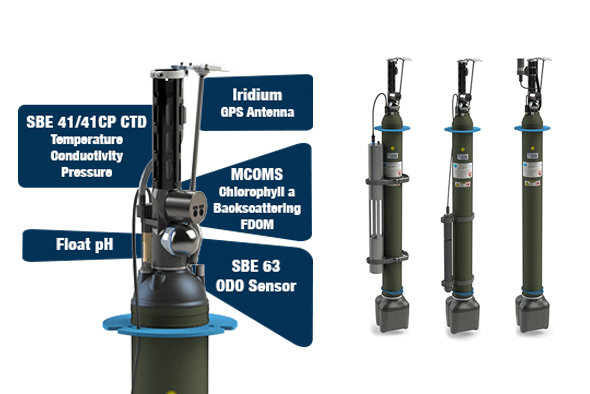
The SBE 41CP CTD, installed on most Argo floats in the world's oceans, is designed to maintain high quality data throughout the float’s lifespan. And since surfacing is a big part of the float’s job (it has to call home at some point), routinely traveling through the potentially-contaminated surface is risky for a high-accuracy sensor. As with the early Argo CTD (and most modern CTD models), reduced salinity accuracy from conductivity cell fouling is the primary concern. So, to avoid ingesting sea surface contaminants, the 41CP makes and obvious trade off: it shuts off its pump at approximately 5 decibars beneath the surface during the ascent, sacrificing surface temperature and salinity for sensor stability over the lifespan of the float.
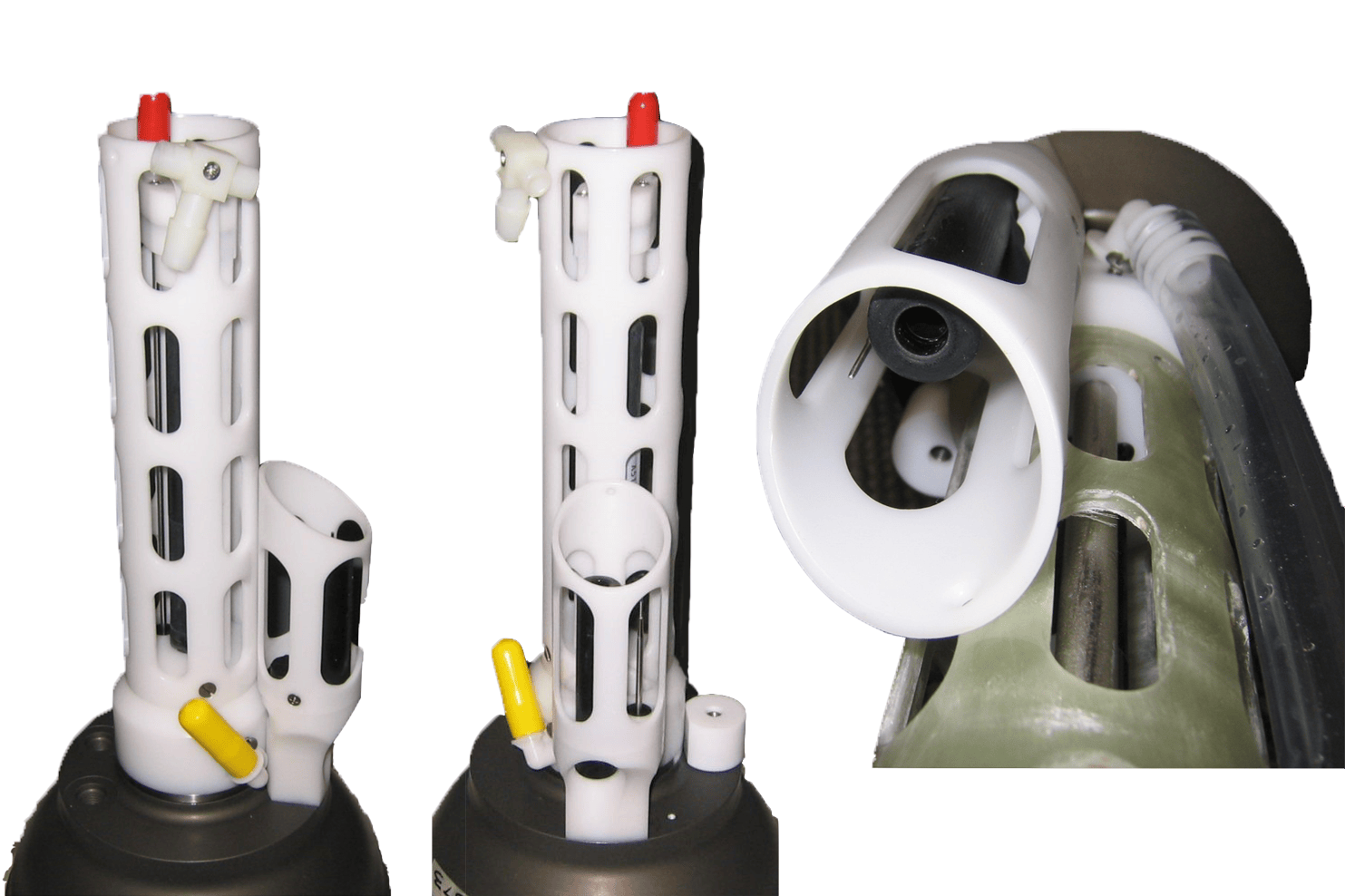
[caption id="attachment_2045" align="alignright" width="300"]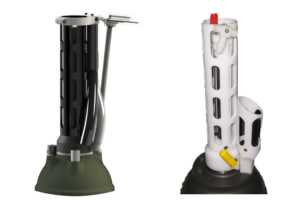 Standard 41CP (left) next to a 41CP with an STS sensor.[/caption]
This is a gap. Measurement of sea surface temperature and salinity provide ground truth for satellites, including NASA’s Aquarius Sea Surface Salinity Mission, and are crucial for determining meteorological fluxes of heat and water. To address this need, Sea-Bird Scientific developed a secondary conductivity sensor designed to make T and S measurements extending through the sea surface. The sensor, called the STS (Surface Temperature Salinity sensor), has an accuracy goal for satellite ground truth of 0.1 psu, and is capable of an order of magnitude better for assessing surface fluxes.
Now, the STS isn’t remarkable on its own. It’s just second, non-pumped conductivity sensor attached to the existing CTD. It is subject to the same surface fouling concerns as the main CTD and is expected to drift over time. However, the pairing of STS with the 41CP CTD allows for dynamic corrections during the float’s deployment - as the STS drifts, comparison to the main CTD’s salinity data can be used to recalibrate the STS and correct for drift. Recall, that the main CTD is effectively “turning off” during the surface to retain data quality. As long as this sensor remains accurate, the STS can be corrected by comparing the data at the float’s park depth (980-960 db) and again in the upper ocean just before the 41CP stops sampling. The resulting correction can lead to accuracy that exceeds 0.01 psu.
To learn more about the STS, and see some data from initial testing, read the poster presentation here.